
Welcome
Summer Meeting Call for Presentations!
The AAS is having a joint meeting this summer to coincide with the Florida Anthropological Society’s 76th Annual Meeting on May 10-12th. See https://fasweb.org/annual-meeting/ for more information.
The call for papers and posters is open! Presentations are scheduled for Saturday, May 11th.
FAS and AAS encourage presentations and posters on a range of topics pertaining to Florida and Alabama anthropology, archaeology, history, and other related disciplines. Presenters must agree to FAS’s code of ethics.
An abstract of no more than 100 words is required from each presenter. Individuals may submit only one paper or poster as first author for consideration. Individuals may submit only one paper or poster as first author for consideration. All presenters must register and pay the appropriate registration fee at the time they submit their abstract. A 20-minute time limit for each paper presentation will be strictly enforced.
Conference registration and abstract submission is available through the FAS website. Abstracts submission deadline is Monday, April 1, 2024. The deadline for proposing an organized session, panel discussion, or other special programs associated with the conference is Monday, March 18, 2024.
Email questions and organized session submissions to Maranda Kles at [email protected].
Special thanks to meeting hosts: Pensacola Archaeological Society, Florida Public Archaeology Network, and the University of West Florida.
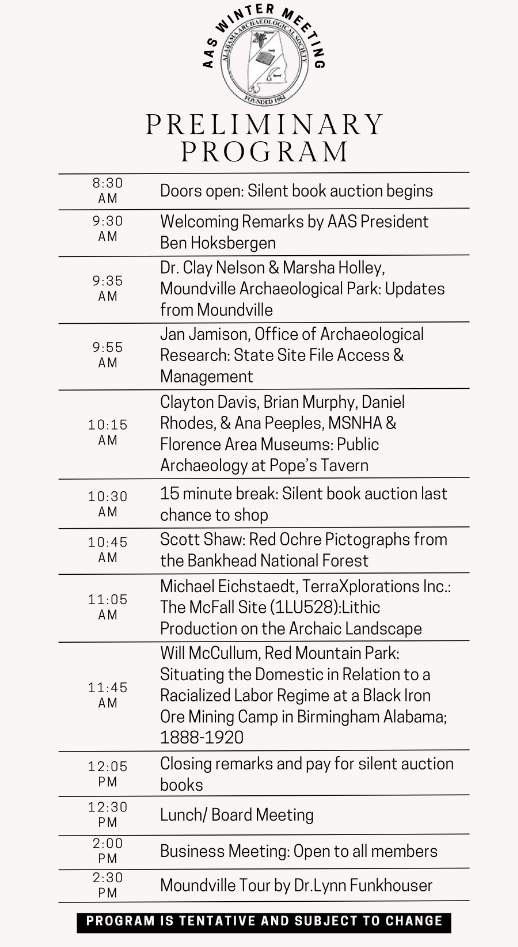
Winter Meeting Tentative Schedule
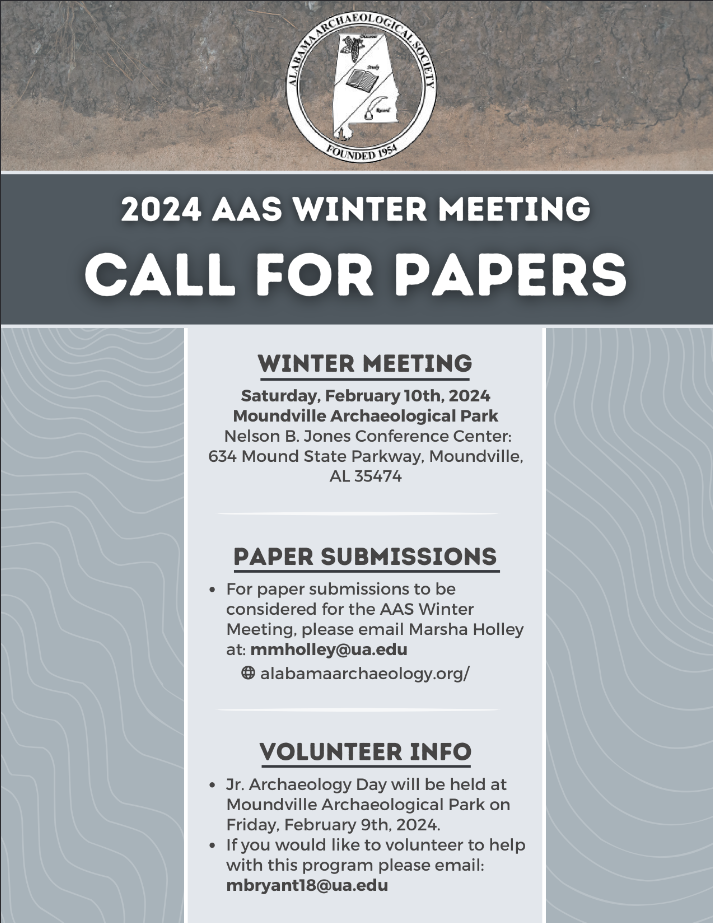
The Winter meeting will be at Moundville on Saturday, February 10th (see program below for more details). Junior Archaeology Day will be held on Friday, February 9th from 11am to 4pm at the Moundville Archaeological Park and Museum.
Note:
Admission to the park is as follows:
Adults – $8
Seniors – $7
Students – $6
Military – $6
Under 5 – Free
Native American visitors – Free with tribal membership card
UA Museums members – Free with museum membership
Address: 634 Mound State Parkway, Moundville, AL 35474-6413
If you’d like to volunteer and help out with Jr. Archaeology Day, please email: [email protected]
The Alabama Archaeological Society is a nonprofit organization chartered under state of Alabama laws. There are no paid officers or staff. All funds come from membership dues and contributions and are used to promote the informed and scientific investigation of archaeological sites, as well as for other educational purposes. Membership is open to everyone.
Find us on Youtube here!
Troy University Chapter has their Welcome Back Speaker Series
Speakers will be presenting in January, and March on the first Tuesday of the month. The speaker series is free of charge.
Our Summer Meeting and Jr. Archaeology Day at Sloss Furnaces was a great weekend!
We had an amazing turn out on Friday for Jr. Archaeology Day. The kids - and adults - learned a lot about stratigraphy, The Ridge at Tuskegee, metal working, flint knapping, as well as what materials were used and can be found at Sloss. The kids also had a chance to excavate a part of a unit! On Saturday we had speakers discuss the history of Birmingham (Pam King), the Western Railway Project (Jeremiah Stager), and Marsha Holley also discussed the success of Jr. Archaeology Day for members who weren’t able to make it, and finished off the weekend with our afternoon tour of Sloss Furnaces.
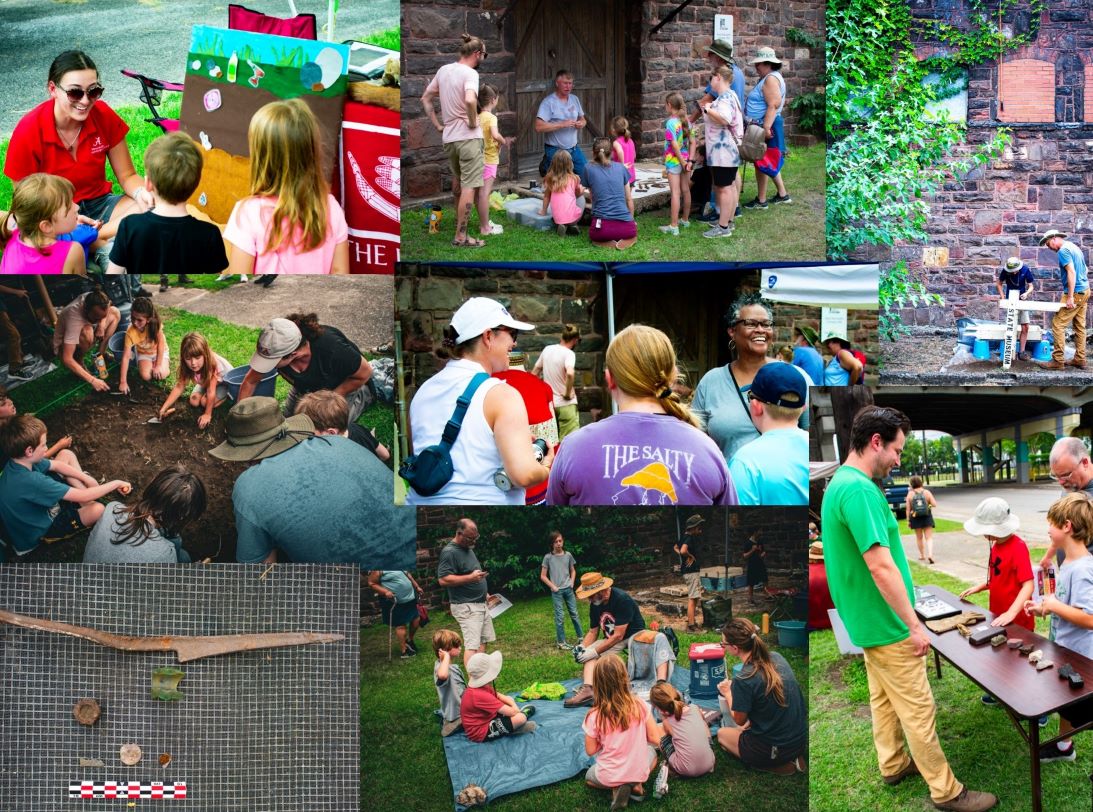
Photos taken by Rebecca Johnson of The University of Alabama Museums
Call for Papers for the Journal of Alabama Archaeology
The Journal of Alabama Archaeology, a peer-reviewed journal, provides the latest research on topics relevant to archaeology of Alabama. Published by the Alabama Archaeological Society, the JAA covers a wide range of subjects encompassing all eras of Alabama archaeology, as well as articles on related topics in the Southeast. The JAA welcomes submissions from professional, amateur, avocational, and student archaeologists. Our journal offers a great opportunity for graduate students and recipients of AAS Scholarships to publish their research.
Prospective authors should consult the journal’s editorial guidelines at https://alabamaarchaeology.org/files/authorsinfo.pdf
For more information, please contact the current editorial team:
Dr. Greg Waselkov, Dr. Heather Puckett, or Dr. Ashley Dumas at [email protected]
The AAS Executive Board has approved a draft of a Sexual Harassment Policy that will be added to the by-laws. However, the policy must be approved by AAS members at large. The vote will take place at one of our seasonal state-wide meetings. The policy draft is presented below. Any comments or questions you have about the policy can be submitted through the website and will be discussed before the board and taken into consideration for the final draft.
The Alabama Archaeological Society (AAS) is committed to the creation and maintenance of an environment in which all individuals, members and non-members, are treated with respect and dignity. The AAS is a nonprofit organization chartered under state of Alabama laws and recognizes the necessity of compliance with all applicable federal, state, and local laws including, but not limited to, those that prohibit discriminatory practices including harassment. Therefore, the AAS will maintain a strict policy of prohibiting unlawful harassment of any kind, including sexual harassment and harassment based on race, color, religion, national origin, sexual orientation, gender identity or expression, sex, age, physical or mental disability or any other characteristic protected by state, federal or local discrimination laws. Sexual harassment includes, but is not limited to, making unwanted sexual advances and/or requests for sexual favors where such conduct has the purpose or effect of substantially interfering with an individual’s mental, physical, and/or emotional well-being and/or creating an intimidating, hostile, or offensive environment. Members and nonmembers who violate this policy are subject to discipline up to and including the possibility of immediate and permanent expulsion from the society and its functions.
Examples of unlawful harassment include but are not limited to:
• Verbal conduct such as epithets, derogatory jokes or comments, slurs or unwanted sexual advances, invitations or comments.
• Visual conduct such as derogatory and/or sexually oriented posters, photography, cartoons, drawings, e-mail, text messaging, social media, or gestures.
• Physical conduct such as assault, unwanted touching, blocking normal movement.
• Threats and demands to submit to sexual requests.
• Retaliation for having reported or threatened to report unlawful harassment.
The AAS is not an adjudicating body; however, there are processes in place to support members in getting their grievances addressed when unwanted behaviors occur in the context of AAS-sponsored events and activities (e.g. conferences, editorial activities, governance events). Effective June 7, 2019, the AAS Board of Directors will receive complaints of harassment in the context of AAS settings and activities. They will ascertain the view of the complainant to determine what outcome they want and, where appropriate, will refer the complainant to the police. For incidents that occur outside the context of AAS-sponsored settings and activities, AAS members and nonmembers should seek out appropriate authorities with which to file claims of sexual harassment and/or sexual assault. Typically, the line of formal complaint is through the perpetrator’s home institution. AAS members should apprise themselves of the appropriate processes at their home institutions, as well as in the legal jurisdictions where fieldwork, meetings, and other business are conducted.
This policy is not intended to constitute legal advice. In the event of any conflict between this policy and applicable laws or institutional policy, the applicable laws or institutional policy prevails. Members and institutions are encouraged to seek their own counsel for advice regarding any specific situation.
The Alabama Archaeological Society will not tolerate sexual harassment or sexual assault of AAS meeting participants (including, but not limited to attendees, speakers, volunteers, exhibitors, AAS members, service providers, or other meeting guests) in any form. By obtaining AAS membership, registering to present or attend AAS meetings, members and participants commit to maintaining respectful and ethical relationships in accordance with the AAS policy. The Alabama Archaeological Society reserves the right to remove an individual violating this policy from organization events without warning or refund, and prohibit attendance at future AAS meetings, programs, and/or activities.
Learn More